Go deeper
Build the kind of agent these lessons explain, with a closed list of actions and an approval step. Needs some Python.

Course
Build an AI agent for your business that picks actions from a closed list you define, waits for your approval on anything you haven't cleared to run alone, and refuses five kinds of action in code: moving money, DNS, deleting, revoking keys and changing itself.
- Level
- Builder: Python
- Format
- Video lessons, PDF, Files (zip)
- You need
- Some Python, or the patience to learn it with Claude beside you
Next lesson
AI Agent vs Workflow: When You Need Each
All lessons in AI Agents Explained Simply
Lesson script
The lesson's script, line by line. The published video's own lines are not on record here, so the video may differ in places.
A chatbot is simple: you ask a question, it gives you an answer, and that's it. If you want something else done, you have to do it yourself, or ask again. A very polite librarian.
An agent gets a goal instead, like: find a free time and book a call. Then it works out the steps by itself.
To take those steps it uses tools: a web search, your calendar, an email draft. Tools are how it touches the world.
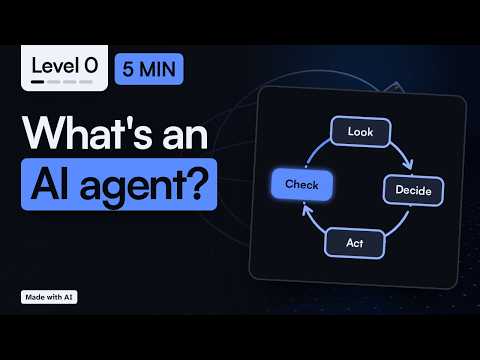
Anthropic describes agents as models using tools based on feedback, in a loop. First, it looks at the situation.
Then it decides on the next step.
Then it acts, usually by using one tool.
And it checks the result, then loops again, until the goal is done or it needs your help. Booking a call might take five turns of this loop: check the calendar, find a gap, draft the invite, notice a clash, and try another time. Nobody wrote those five steps in advance. The agent worked them out as it went, one look at a time.
Quick quiz. What makes something an agent? Comment your answer.
It's B. An agent picks its own next step and which tool to use.
A workflow, like the ones we build in n8n, follows steps written in advance. Same path every time.
An agent lets the model decide the path. That's more flexible, but harder to predict, and it usually takes longer, because the model thinks before every step.
Anthropic's own advice is to find the simplest solution that works, and only add complexity when you need it. Often a workflow is enough.
If this is helping, subscribe. This series goes from the basics to building agents safely.
Let's make it real with three examples. Saving every new form entry to a spreadsheet is the same every time, so a simple workflow is perfect.
Sorting your inbox and drafting replies needs judgment: which email matters, and what to say. An agent can help there, with you checking the drafts before anything is sent.
And researching a topic means searching, reading, then deciding what to look at next. Nobody can write those steps in advance, so that's agent work.
Pause the video and think of one task you do every week.
Are the steps always the same, or does it need decisions along the way? Resume when you have your answer.
Agents can make mistakes, so a person stays in charge. First, give it only the tools it really needs.
Second, it pauses and asks you before anything important: sending, paying, or deleting.
Third, a stopping rule, like a limit on how many steps it may take, so it can't loop forever. When it hits the limit, it stops and tells you what it tried, so you can decide what happens next.
Last quiz. An agent wants to send an email for you. What's the best setup?
B. It asks you first. Approval before anything leaves.
Recap. A chatbot answers; an agent takes steps toward a goal.
It works in a loop: look, decide, act, check.
Use a workflow when the steps are fixed, and an agent when they're not.
And keep a person in charge. Next time: when to use an AI agent, and when a simple workflow is better.