Go deeper
Build the kind of agent these lessons explain, with a closed list of actions and an approval step. Needs some Python.

Course
Build an AI agent for your business that picks actions from a closed list you define, waits for your approval on anything you haven't cleared to run alone, and refuses five kinds of action in code: moving money, DNS, deleting, revoking keys and changing itself.
- Level
- Builder: Python
- Format
- Video lessons, PDF, Files (zip)
- You need
- Some Python, or the patience to learn it with Claude beside you
Next lesson
AI Agent Tools, Memory and Planning, with Diagrams
All lessons in AI Agents Explained Simply
Lesson script
The lesson's script, line by line. The published video's own lines are not on record here, so the video may differ in places.
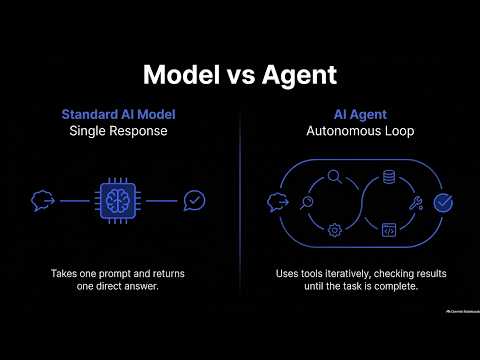
Let's start with three words. A model reads your prompt and writes an answer. One question in, one answer out.
An agent is a model that uses tools in a loop. It acts, looks at the result, and decides what to do next.
And agentic system is Anthropic's umbrella word. It covers both workflows and agents.
So what's the difference inside that umbrella? In a workflow, the model and tools follow a path written in advance.
In an agent, the model directs its own process. It decides which tool to use, and when.
Both count as agentic systems. The question is just: who picks the steps?
Quick quiz. A model uses tools in a loop, checking each result, until the job is done. What is it? Comment your answer.
B, an agent. The loop is what makes it one.
Every one of these starts from the same building block: a model with extras. First, retrieval, so it can look things up.
Second, tools, so it can actually do a step, not just talk about it.
And third, memory, so it keeps what matters from one step to the next.
If this finally makes all that jargon click for you, subscribe.
Here's a real one, drawn as an n8n workflow. A customer emails to ask where their order is.
The AI Agent node has a chat model and some tools. It decides which tool to call: here, look up the order.
It reads the result, and drafts a reply based on what it actually found.
Then a person approves. n8n can require human approval before an agent uses a tool, like sending the email. Deny it, and it doesn't run.
So what made that agentic? First, nobody wrote look up the order into the path. The agent chose it.
Second, it checked the real result, the order data, before it wrote anything. Anthropic calls that ground truth from the environment.
Third, it has a limit. In n8n, Max Iterations caps how many times the model runs. The default is ten. Without a limit, a confused agent could keep going.
Pause the video and pick one job from your week.
Does it follow the same steps every time, or does it need choices? Resume when you've decided.
Before you build one, ask: what's the simplest thing that works? Anthropic's own advice is to add complexity only when it's needed. Sometimes that means no agent at all.
Agents trade speed and cost for flexibility. That's worth it when you can't predict the steps.
And when you do build one, test it somewhere safe first, and keep a person approving anything that matters.
Last quiz. A workflow runs the same steps every time, and Claude writes one reply in the middle. Is it an agent? Comment.
B, it's a workflow. The path is fixed, even though a model is inside it.
Recap. A model takes one prompt and gives one answer.
An agent uses tools in a loop, and picks its own steps.
Agentic systems cover both workflows and agents.
And whichever you build, start simple, set a limit, and keep a person approving what matters. Next time: how AI agents use tools, memory and planning.