Go deeper
An agent you build and run yourself, which picks from a closed list of actions and asks before it acts. Needs some Python.
Course
Build an AI agent for your business that picks actions from a closed list you define, waits for your approval on anything you haven't cleared to run alone, and refuses five kinds of action in code: moving money, DNS, deleting, revoking keys and changing itself.
- Level
- Builder: Python
- Format
- Video lessons, PDF, Files (zip)
- You need
- Some Python, or the patience to learn it with Claude beside you
Next lesson
What Is Hermes Agent? Nous Research's Open-Source Agent, and Why Run AI Locally
All lessons in Local AI: Hermes Agent on NVIDIA DGX Spark
Lesson script
The lesson's script, line by line. The published video's own lines are not on record here, so the video may differ in places.
Let's start with one word: model. A model is the part of an AI app that actually does the thinking. You send it words, and it sends words back.
It learned by reading a huge amount of text, way more than any of us will ever read, and it's very good at working out what a helpful answer looks like.
And here's the key point. In the end, a model is stored as files on a computer. Whoever has those files, and a strong enough computer, can run it.
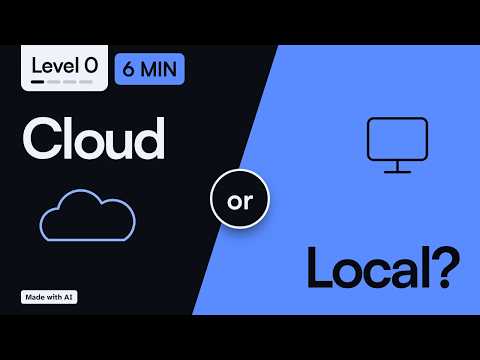
So there are two places a model can run. In the cloud, you type into an app, your words travel over the internet to a company's computers, the model answers there, and the answer comes back.
Local means the model runs on a computer you own. Your words go to your own machine, and the answer is made right there. Nothing has to leave.
Quick quiz. You use an AI chat app in your browser. Where does the model usually run? Comment your answer.
It's B, the cloud. Your words travel to the company's computers and the answer comes back.
Why would anyone run AI themselves? First, privacy. Some notes, files and customer details are things you'd rather not send anywhere.
Second, control. You choose the model, and it only changes when you decide to change it.
And third, it can work offline, once everything is installed. No internet, still an answer. Handy on a train.
But it's not free of trade-offs. You need a capable computer, and running models asks a lot of it.
You set everything up yourself, and you keep it running and up to date. Nobody does that for you.
And the biggest models from the big cloud companies may not run on your machine at all. Local is a choice, not an automatic upgrade.
If you want to see this done for real, subscribe. This series builds a full local setup, step by step.
When people ask what computer they need, the first question is memory. A model has to fit in memory to run well.
Bigger models usually need more memory. So the model you want decides the machine you need, not the other way around.
Always check the official guides for your hardware before you buy anything. In this series, we follow NVIDIA's own published guides, never guesses.
Last quiz. What's the first hardware question for local AI? Comment.
B, memory. The model has to fit in memory to run well.
One more idea, and it's the reason for the rest of this series. A model answers what you ask. That's all it does.
An agent is a program around the model. It can use tools, like reading a file or searching, and work through a task step by step.
Next episode, we meet Hermes Agent, an open-source agent from Nous Research, that can talk to a model you run yourself.
Pause the video and think. Write down one task you'd want to keep private,
and ask yourself, would it need the internet? Resume when you have it.
Recap. A model is the part of AI that thinks, and it's stored as files.
Cloud means their computers. Local means yours.
Local gives you privacy, control and offline use, with real trade-offs.
And memory is the first hardware question. Next time: what Hermes Agent is, and why you might run AI yourself.